
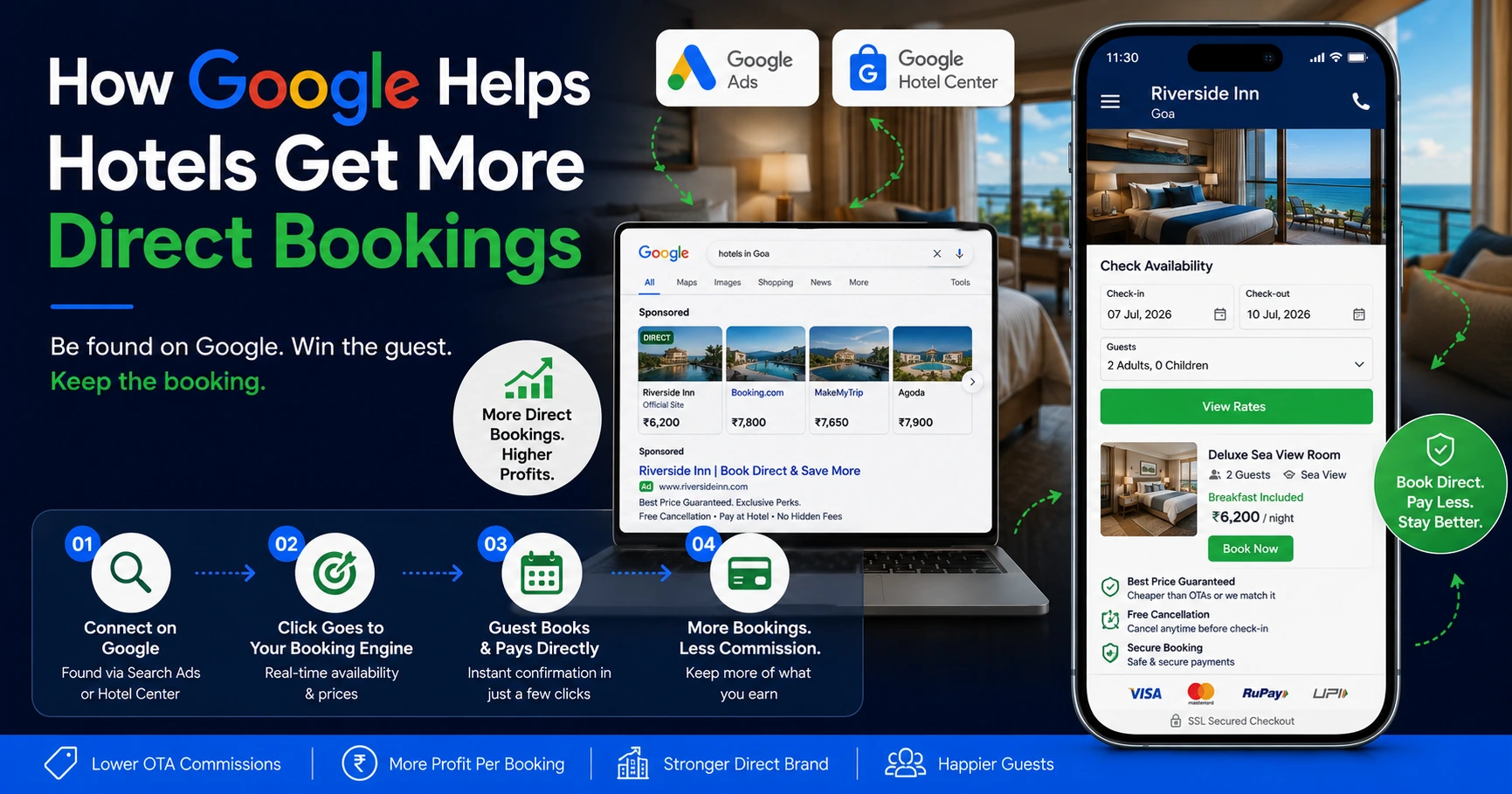
If your hotel shows up on Google — whether through a Search ad or through Google Hotel Center’s price box — here’s a question worth asking honestly: when a guest clicks through, where do they actually end up? For a lot of hotels, the answer is “somewhere that isn’t really ours” — a generic contact page, or worse, the guest searches your hotel name, sees an OTA’s listing sitting right there next to yours, and books through Booking.com or MakeMyTrip anyway because that’s the result they recognize. You just paid for a click, or missed a free comparison you could have won, and still handed your own guest to a middleman.
This guide walks through how to fix that, in plain terms, so however a guest finds you on Google, it actually turns into a booking you keep the full value of.
Why Are You Even Paying For Traffic If You’re Already On OTAs?
Here’s the thing about OTAs like Booking.com or MakeMyTrip — they’re already spending millions on their own Google visibility, targeting the exact same guests you are. So when a guest searches “hotels in [your city],” it’s entirely normal for an OTA listing of your own hotel to show up right next to, or even above, yours.
If that guest then lands somewhere that doesn’t clearly let them book directly, they’ll often just click the familiar OTA link instead. You end up paying for the click (or missing the free comparison), and the OTA still takes its 15-25% commission on the booking anyway. That’s the worst version of this — paying twice for one guest.
The Ad Works. Then The Click Goes Nowhere Useful.
This is the part hotels get wrong most often with Google Ads campaigns specifically. The ad copy is fine, the targeting is fine, the guest clicks — and then lands on a homepage with a phone number, or a generic “contact us” form, or a page that loads slowly and doesn’t show real prices. None of that closes a booking. A guest comparing five hotels at once isn’t going to wait for a callback; they’ll go back to Google and click the next result.
The click itself was never the hard part. What happens in the three seconds after the click is what decides whether that ad spend turned into a booking or got wasted — and it’s not just our opinion; Google’s own guidance for advertisers makes the same point, treating a relevant, fast landing page as one of the biggest factors in whether a search ad actually performs.
There’s A Second Way To Show Up On Google — Hotel Center
Search ads aren’t the only paid option. If you’ve ever searched for a hotel and seen a box with room photos and prices from a few different websites sitting side by side, with a small “Sponsored” label above it — that’s a different tool, and it works differently from a regular ad.
Instead of one link, it shows your price directly next to OTA prices for the same room, same dates, right there in the results. A guest can compare your rate against Booking.com’s rate for your own hotel without even leaving Google. If your direct rate is equal to or better than the OTA’s, this is often the single most effective way to win that guest back before they ever click through to an OTA at all.
Setting this up is a separate piece of work from a Search ads campaign — it runs through Google Hotel Center, connected to your live rates so guests always see accurate pricing, not outdated numbers. Worth knowing both options exist, because a hotel using only one is leaving half the opportunity on Google unclaimed.
Where Should That Click Actually Land?
Whichever of the two brought the guest in, the answer to where they should land is the same: your own Booking Engine — a page that shows real availability and real prices for the exact dates they’re searching, and lets them pay and confirm the room right there, without leaving your site or calling anyone.
This sounds obvious once it’s said out loud, but a surprising number of hotel websites don’t actually have this set up properly. Some show prices that are out of date. Some require an email back-and-forth to confirm anything. Every extra step is another chance for the guest to give up and book somewhere else instead.
What Is A Booking Engine, In Plain Words?
You’ll hear this phrase a lot, so let’s be clear about what it actually means: a booking engine is simply the part of your website where a guest can check real availability, see the actual price for their dates, and pay to confirm the room — all without talking to anyone. It’s the same idea as the “book now” button on Booking.com, except it belongs to you, and you don’t pay a commission on what it books.
A good one does a few specific things well: it shows live pricing, it works properly on a phone (most guests are booking from their phone, not a laptop), and it lets a guest complete payment in the same visit instead of “reserving” and hoping they follow up later.
A Landing Page Guests Trust Enough To Pay On
Even with a good booking engine, guests still hesitate to pay directly on a hotel’s own website sometimes — mostly because OTAs have trained people to expect free cancellation, visible reviews, and a familiar checkout process. If your booking page doesn’t show your cancellation policy clearly, doesn’t mention that the price is the same or better than OTAs, and doesn’t show any guest reviews or trust signals, some guests will quietly go back to the OTA listing just to feel safer about the purchase.
None of this needs to be complicated. A clear cancellation policy, a note that direct bookings sometimes get a small perk (a free room upgrade or late checkout, for example), and a couple of genuine guest reviews visible on the same page can be enough to keep a guest from second-guessing the decision.
Putting It Together, Step By Step
- Guests searching for a hotel in your city, or your hotel’s name directly, can find you two ways on Google — a Search ad, or your live rate showing in the Hotel Center price box.
- Either way, that link should point straight to your booking engine page for the relevant dates — not your homepage, not a contact form.
- That page shows a real, live price and lets the guest book and pay immediately.
- The page includes a visible cancellation policy and a small reason to book direct (a perk, a lower price, or both).
- If the guest doesn’t complete the booking, a follow-up on WhatsApp — the same kind of automatic nudge a WhatsApp automation sends on its own — reminds them before they book elsewhere.
Every one of these steps matters on its own, but skipping any single one usually means losing the guest at that exact point.
What This Costs You If You Get It Wrong
It’s worth being direct about the actual cost here. Say your ad costs ₹40 for a click, and the guest who clicks it ends up booking through an OTA anyway because your own site didn’t convince them to book direct. You’ve paid ₹40 for the click, and then paid roughly 15-25% of the entire booking value in OTA commission on top of it — for a guest Google brought to you in the first place. Fixing where that click lands doesn’t just win you more bookings, it removes a cost you were paying twice for the same guest.
Where To Start
Whichever way you’re already showing up on Google — Search ads, Hotel Center, or both — the fastest thing to check today is simple: click through as if you were the guest and see where it actually sends you. If it’s not your booking engine, with a real price already showing for real dates, that’s the first thing to fix, often before touching either campaign at all.
If you don’t have a booking engine that can actually take a payment and confirm a room on its own, that’s the more foundational piece to put in place first — because no amount of visibility on Google fixes a landing page that can’t close the booking.