
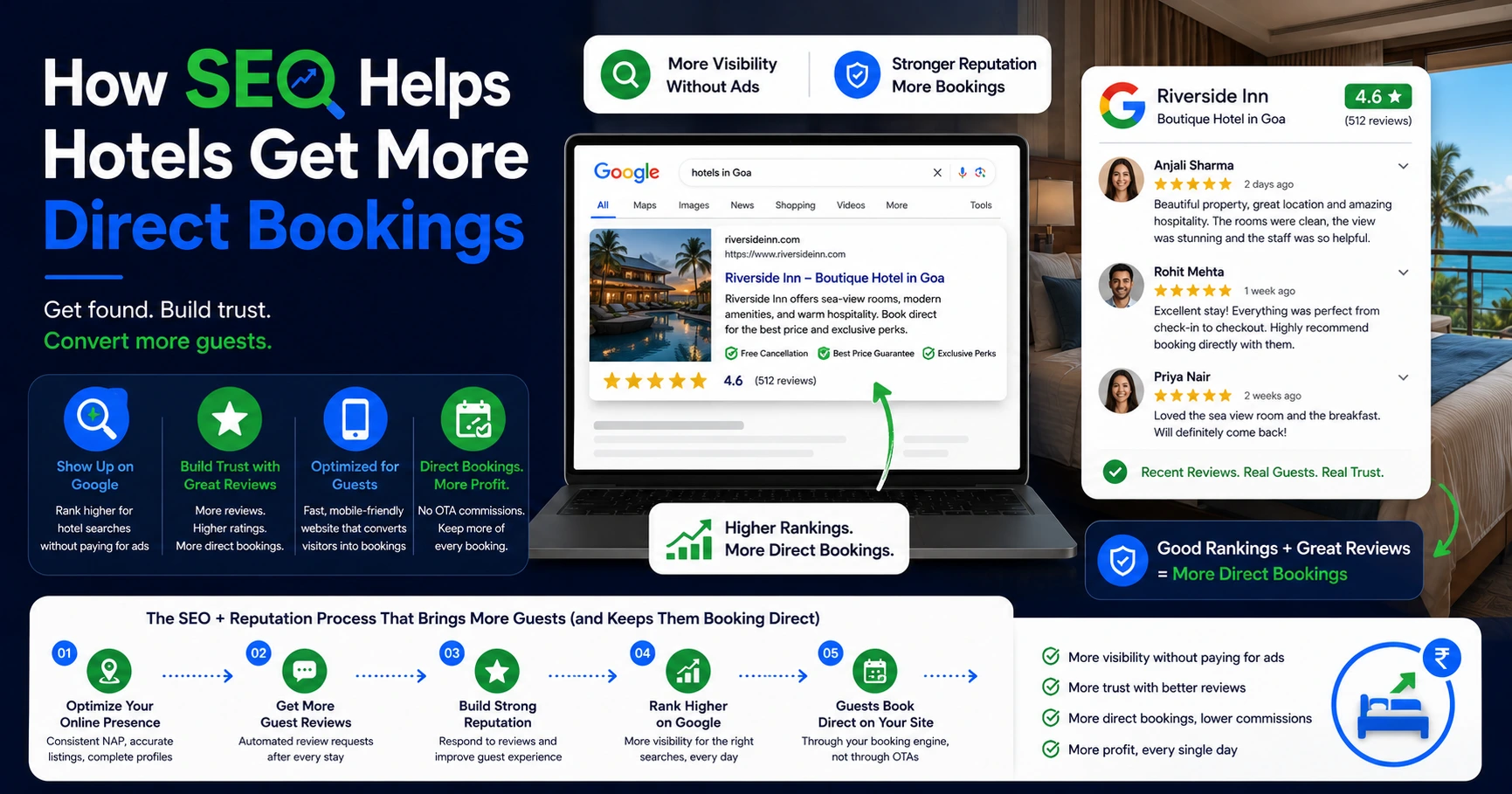
Ads work, but they only work while you’re paying for them. The moment the budget stops, so does the traffic. Mastering hotel SEO direct bookings offers a second way guests find and choose your property without paying per click — and it keeps working long after ad budgets run out.
This guide is about that second way: showing up on Google without paying for it, and looking trustworthy enough once you’re found that a guest books with you directly instead of through an OTA.
The Two Free Ways Guests Find You Without An Ad
There are really just two things doing the work here. First, whether your hotel actually shows up when someone searches for a hotel in your city — that’s what SEO is about. Second, once they do find you, whether what they see makes them trust you enough to book — that’s mostly down to your reviews and reputation. Get the first one right without the second, and guests find you but book elsewhere. Get the second right without the first, and nobody finds you to be impressed by in the first place. They only work together.
Hotel SEO Direct Bookings: Showing Up On Google
Here’s what SEO actually means, in plain words: it’s the work that helps your hotel’s own website show up naturally in Google’s search results — not in the “Sponsored” section, in the regular list below it — when someone searches something like “hotels in [your city]” or “[your hotel’s name].”
Google decides what to show based on things like whether your website actually answers what the guest is searching for, how fast your pages load, whether your hotel’s name, address and phone number are consistent everywhere online, and how many other websites or directories mention and link to you. Your OTA listings on Booking.com, MakeMyTrip or TripAdvisor count here too — Google treats these as some of the highest-authority mentions of your hotel online, so keeping every OTA listing accurate, complete and consistent with your own website is part of the same SEO groundwork, not a separate task. This is exactly the kind of listing accuracy OTA Management is responsible for keeping in order, alongside the work covered under SEO itself — making sure your hotel is the one Google actually chooses to show, not just one of many that exist.
Once They Find You, Do They Trust You Enough To Book?
Getting found is only half of it. A guest who finds your hotel on Google will almost always check your reviews before deciding anything else — often before even opening your website. If your last review is from two years ago, or your rating is sitting at 3.2 stars, most of that hard-earned visibility just gets undone right there.
This is where reputation comes in, and it’s simpler than it sounds: ask every guest for a review after they check out, respond to the ones you get (good and bad), and fix whatever keeps showing up as a complaint instead of ignoring it. A steady stream of recent, genuine reviews does more to convince a guest to book direct than almost anything else on your website. This is exactly what Reputation Management is built around — making sure the reviews a guest sees are recent, honest, and working in your favour instead of against it.
One practical way to make this consistent instead of occasional: automate the ask. A simple message to every guest a day or two after checkout, asking for a quick review, brings in far more reviews than hoping guests remember to leave one on their own — this is something a Guest CRM can handle automatically for every single stay, without anyone at the front desk having to remember to ask.
Where This Traffic Should Land
Same rule as always applies here too: once a guest is convinced enough to book, that click needs to land on your own Booking Engine — showing a real price for their exact dates, with a clear cancellation policy, letting them pay and confirm the room right there. All the SEO and reputation work in the world doesn’t matter if the guest gets found, gets convinced, and then has to call a number or wait for an email just to actually book.
The One Honest Downside: This Takes Longer Than Ads
It’s worth being straightforward about this: SEO and reputation work don’t show results in a week. An ad can bring a guest in today; a better search ranking or a stronger review score usually takes a few months of steady, consistent work before it shows up clearly in bookings. That’s the trade-off — ads are fast and stop the moment you stop paying, SEO and reputation are slow to build but keep working on their own once they’re in place.
The hotels that do best usually aren’t choosing one over the other — they run ads for the traffic they need right now, while the SEO and reputation work quietly builds the traffic they won’t have to pay for later.
Putting It Together, Step By Step
- Make sure your hotel’s name, address and phone number are exactly the same everywhere online — your website, Google Business Profile, and any directory listing.
- Ask every guest for a review within a day or two of checkout, ideally automatically rather than occasionally.
- Respond to every review you get, good or bad — an unanswered bad review sitting there for months does more damage than the review itself.
- Make sure your website actually loads fast and works properly on a phone, since a slow site quietly undoes a lot of the ranking work.
- Send anyone who does find you straight to a booking engine that can actually confirm the room, not just a phone number.
Where To Start
If you had to pick just one thing to start this week, make it the reviews — it’s the fastest of these to actually move, and it’s usually the first thing a guest checks anyway. Everything else here compounds over months; reviews can start shifting within weeks of asking properly.