
Ask ten hotel owners which OTAs they are on and you will hear ten different answers. Some are on one site and wonder why bookings are slow. Others are on eight and spend every evening fixing rates and closing rooms by hand.
Online travel agencies are useful partners. They put your rooms in front of travellers who would never find you otherwise. But more listings do not automatically mean more bookings. The right mix depends on your property, your guests and how much time your team has to manage it.
This guide walks through the main OTAs used by Indian hotels, who each one tends to reach, and how to manage several of them without losing control.
Why You Do Not Need To Be On Every OTA
Every OTA you add is one more extranet to update. That means one more set of photos, rates, room counts, policies and guest messages.
Without the right systems, each new listing raises the risk of overbookings, mismatched prices and stale content. A listing that is half-maintained can hurt more than it helps, because guests compare prices and read old reviews.
So the better question is not “How many OTAs can I join?” It is “Which OTAs bring the guests I want, and can I manage them properly?”
The Main OTAs For Indian Hotels
MakeMyTrip and Goibibo. Both belong to the same group and share one partner extranet, called InGo-MMT. You manage inventory, rates and promotions for both brands from one place (InGo-MMT help centre). For most Indian properties, this is the starting point for domestic travellers.
Booking.com. Strong with international guests and growing with domestic ones. Useful for city hotels, heritage stays and properties on foreign tourist circuits.
Agoda. Part of the same parent group as Booking.com, with a strong base among travellers from Asia. Worth considering if you see guests from Southeast Asia or the Middle East.
Airbnb. Built for homestays, villas, serviced apartments and boutique properties with a distinct character. Guests here often book longer stays and care about the experience as much as the room.
Expedia. Reaches international travellers, especially from North America and Europe. More relevant for properties in major tourist destinations.
Cleartrip, EaseMyTrip and Yatra. Domestic platforms with their own loyal users. Cleartrip is owned by Flipkart and also shows hotels inside the Flipkart app. These can add steady domestic demand once your main listings are running well.
How To Choose The Right OTAs For Your Property
Start with your guests, not the platforms. Look at your last few months of bookings and walk-ins and ask where people come from and why they travel.
- Business or city hotel, mostly domestic guests: start with MakeMyTrip & Goibibo, then add Booking.com and Cleartrip.
- Leisure resort in a domestic tourist spot: start with MakeMyTrip & Goibibo and Booking.com, then add Agoda or EaseMyTrip.
- Heritage or boutique stay with foreign visitors: start with Booking.com and MakeMyTrip & Goibibo, then add Expedia and Airbnb.
- Homestay, villa or serviced apartment: start with Airbnb and MakeMyTrip & Goibibo, then add Booking.com.
This is a starting point, not a rule. A hill-station resort near an airport with direct flights from Southeast Asia may see more value from Agoda than this list suggests. Watch your own booking data for a few months and adjust.
What To Prepare Before You List
A good listing takes less than a day if you have these ready:
- Photos. Bright, recent pictures of every room type, bathrooms, common areas and the view. Avoid heavy filters.
- Room details. Size, bed type, maximum guests and amenities for each room type, written the same way on every site.
- Rates and policies. Your base rates, meal plans, cancellation rules and child policy, decided in advance.
- Documents. Business registration, GST details if applicable, ID proof and bank details for payouts.
- A description. A short, honest paragraph about what makes your property worth staying at. Keep it consistent across sites.
Getting this right once saves hours later. It also keeps your property looking the same wherever a guest finds it.
How To Manage Several OTAs Without Losing Control
Once you are on two or three OTAs, the work changes. It is no longer about listing. It is about keeping everything in sync every day.
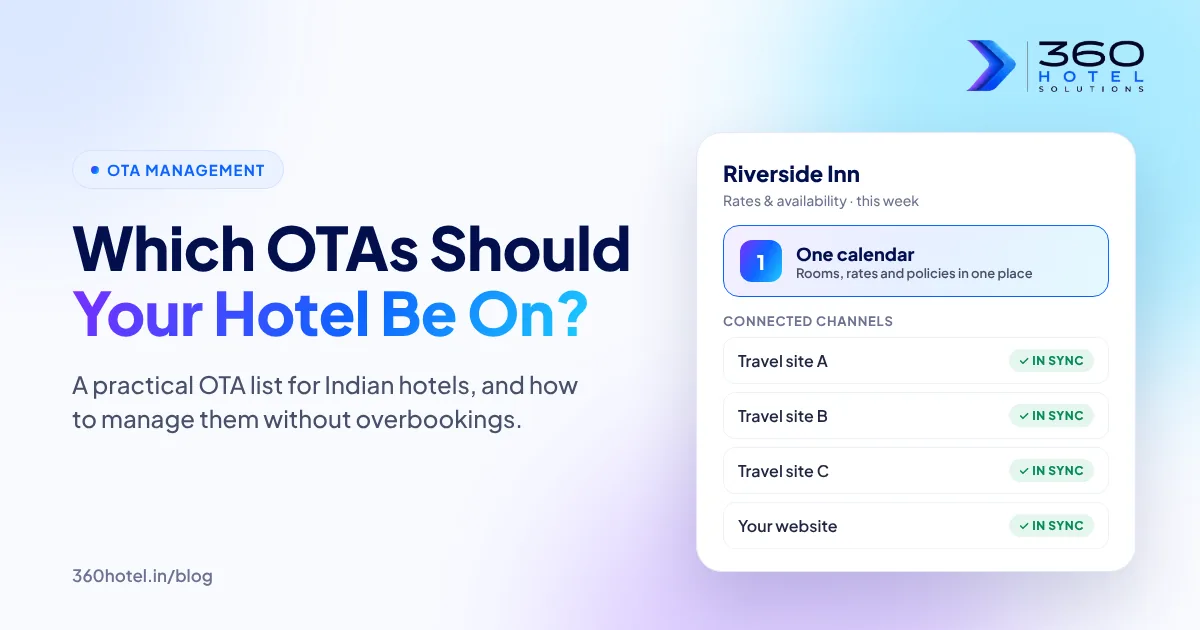
Use a channel manager. A channel manager connects your OTA listings to one calendar. When a room is booked on one site, availability updates on the others. This is the single biggest protection against overbookings. Updating each extranet by hand works for one listing, but it breaks down quickly after that.
Keep your rates consistent. Guests compare prices across sites and on Google. If one OTA shows a much lower rate than another, or lower than your own website, it confuses guests and can create problems with the platforms. Decide your rate plan once and push it everywhere from one place.
Keep content fresh. Update photos when you renovate. Add new amenities. Remove anything you no longer offer. An outdated listing leads to disappointed guests and weaker reviews.
Reply to reviews. Thank guests for good reviews and respond calmly to complaints. Future guests read your replies as closely as the reviews themselves.
Use promotions carefully. Most OTAs offer deals, mobile-only rates and paid visibility options. These can help in slow periods, but each one usually costs extra commission or a discount. On MakeMyTrip and Goibibo, for example, sponsored listings are only available once your property has a rating of 3.5 or more on both platforms. Test one promotion at a time and check whether it brings bookings you would not have got anyway.
What About Commission?
OTAs charge a commission on each booking, commonly in the range of 15–25% depending on the platform, your contract and any promotions you join. That is the price of reaching their audience, and for many hotels it is worth paying.
The issue is not commission itself. It is when almost every booking comes through OTAs, including guests who already know you and would happily have booked direct. That is where a strong direct booking setup makes a difference.
OTAs And Direct Bookings Work Best Together
Think of OTAs as the shop window and your website as the front desk. Many guests discover you on an OTA, then search your hotel name on Google before booking. If they find a clear website with a working booking engine and your direct rate shown next to the OTA prices through Google Hotel Center, some will book with you directly.
That gives you a healthier mix:
- OTAs bring new guests who have never heard of you.
- Your website and Google listing turn returning and well-informed guests into direct bookings.
- A channel manager keeps both sides in sync, so you never sell the same room twice.
We covered how Google shows your official rate in our guide to Google Hotel Center.
Where To Start
- List on the one or two OTAs that match your guests best.
- Get photos, room details and rates right before going live.
- Connect a channel manager before adding a third OTA.
- Make sure your own website can take bookings and shows up on Google.
- Review your booking mix every few months and adjust.
If you would like help with OTA setup and day-to-day management, see our OTA Management service, or get a free Hotel Health Check and we will review your current listings for you.